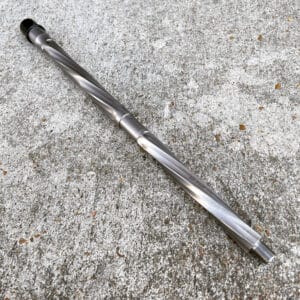
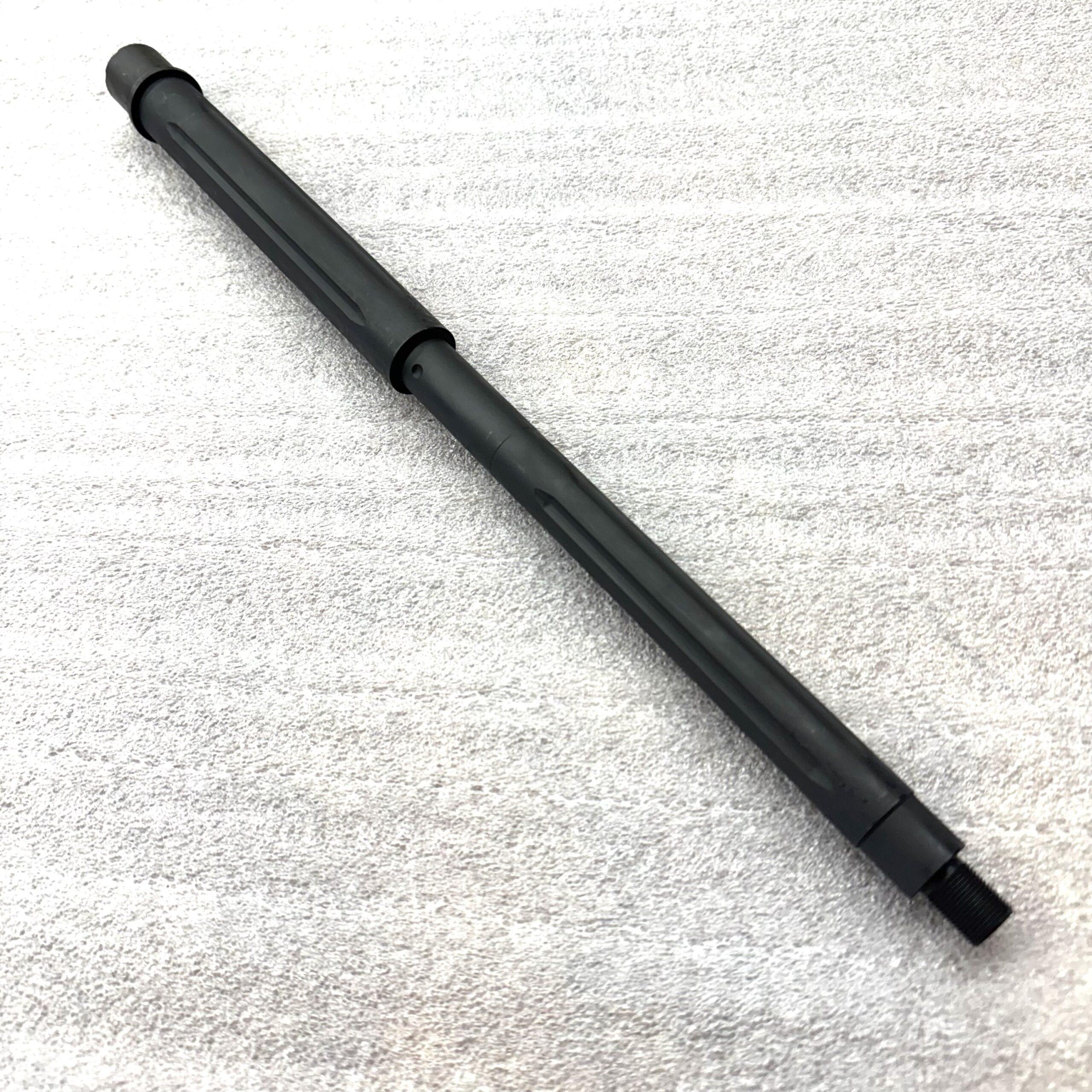
Look at enough rifles and you’ll notice that some barrels aren’t smooth. They have grooves cut into the outside, running straight toward the muzzle or twisting around the barrel. Those grooves are flutes, and you’ll find them on everything from lightweight hunting rifles to AR-15 builds.
Fluting takes weight off. That part is simple. What it does to heat and stiffness is more interesting, and it’s where a lot of marketing gets ahead of the facts. Below you’ll find the common patterns, what fluting really does, where it falls short, and how it stacks up against a plain barrel.
What Is a Fluted Barrel?
Barrel fluting means machining grooves into the outside of a barrel, usually with a milling cutter working along its length. The grooves have nothing to do with the rifling inside the bore, which is what grips the bullet and spins it. Flutes only change the barrel’s outer shape and how much steel it carries.
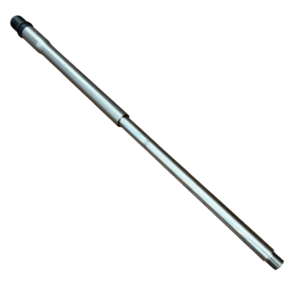
Set one next to a standard non-fluted barrel, which is round and smooth from end to end, and the difference is purely on the outside. Caliber, twist rate, and chambering stay exactly the same.
Many barrels come fluted from the factory. Others get fluted later by a gunsmith, which is a separate decision with its own risks. More on that further down.
Types of Barrel Fluting Patterns
Most types of barrel fluting differ in how the cuts are shaped and how they look. Very little of that shows up on target. Pick a pattern with your eyes, and judge performance by the barrel as a whole.
Straight Fluting
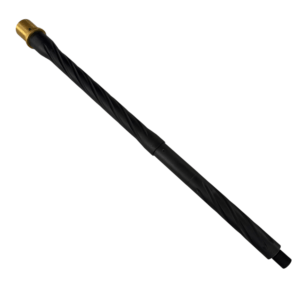
Straight flutes run parallel to the bore, usually as evenly spaced channels around the barrel. It’s the simplest pattern to machine and the one you’ll see most often. A straight fluted barrel looks clean and a little understated, which is why it turns up on so many hunting and sporting rifles.
Spiral Fluting
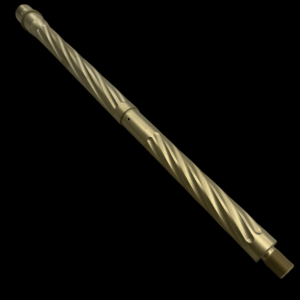
On a spiral fluted barrel, the grooves wrap around the barrel as they travel toward the muzzle. It’s a striking look, and it often gets sold as better for cooling or accuracy. We haven’t seen solid evidence for either claim. A spiral flute removes steel much like a straight one does, and the barrel’s contour, material, and build quality decide how it shoots.
Diamond Fluting
A diamond fluted barrel has two sets of spiral cuts running in opposite directions. Where they cross, they leave a raised diamond pattern. It’s the most decorative of the three main styles, and since it takes more machine time, it tends to cost more.
Other Fluting Patterns
Beyond those three, you’ll run into corkscrew fluting with tight, closely spaced twists, spiral skip fluting that breaks the spiral into short segments, and dimple fluting, which swaps channels for rows of shallow depressions.
Manufacturers don’t always agree on what to call these, so trust the product photos over the name. And none of them touch the rifling.
Benefits of a Fluted Barrel
The clearest fluted barrel benefits are less weight and a look some shooters love. Heat is the one people argue about.
Reduced Weight
Every flute removes steel, and steel is heavy. On a hunting rifle you carry up and down ridges all day, a few ounces matter a lot more than they do at the bench. On an AR-15, much of the weight you feel when shooting offhand sits out front in the barrel and handguard, so trimming the barrel makes the rifle easier to hold up and swing.
Competition shooters split on this. In multigun and other events where you’re moving between positions, lighter usually wins. Precision shooters who stay put often prefer a heavier rifle that settles down and soaks up recoil.
Just don’t assume fluting makes a barrel light. A heavy-profile barrel with deep flutes can still weigh more than a slim sporter barrel with none. If weight is the goal, compare finished weights on the spec sheet.
Heat Dissipation
Flutes add surface area, and more surface area lets heat escape into the air faster. The catch is that they also remove steel, and that steel was soaking up heat. With less mass to absorb it, a fluted barrel can get hot sooner during a fast string of fire.
In a Shooting Illustrated heat test of four 24-inch 6.5 PRC barrels on Savage 110 actions, the fluted steel barrel cooled a bit faster than a medium-heavy steel barrel, though more slowly than the two carbon-fiber barrels. After a quick 15-shot string, its muzzle read about 115°F against roughly 126°F for the heavier barrel, while its chamber ran a few degrees warmer. The two steel barrels came from different rifles with different contours, though, so the test can’t give fluting all the credit.
Wind, air temperature, barrel contour, and how fast you shoot all move the numbers too. And a barrel that cools quicker between strings won’t necessarily stay cooler while you’re shooting.
Distinctive Appearance
Looks are the one benefit you can judge in a second. Straight flutes read as traditional. Spiral and diamond patterns are louder, and they’re usually what people mean when they say a barrel looks custom.
If one of them makes you want the rifle more, that’s a perfectly good reason to buy it.
Potential Drawbacks of Barrel Fluting
Fluting costs money. It’s extra machining, and fancier patterns take longer to cut. If your rifle spends most of its life on a bench at a stationary range, you’re paying to save weight you’ll never carry.
Stiffness is where people get confused. Cut flutes into a barrel and it becomes less stiff than it was before. Compare barrels of the same weight, though, and a larger-diameter fluted barrel can come out ahead of a thinner plain one. Stiffness climbs steeply with diameter (the diameter term in the formula is raised to the fourth power), so where the steel sits counts for more than how much of it there is. Engineers call this property area moment of inertia.
Flutes also change how a barrel vibrates when it fires. Some makers pitch that as an accuracy upgrade, but a change in vibration can help or hurt, and sloppy machining can leave uneven walls or stress in the steel. On aftermarket work, a bad job can also put your warranty at risk.
Fluted vs Non-Fluted Barrel: What’s the Difference?
Comparing fluted and non-fluted barrels only works if the barrels are otherwise alike. Length, contour, steel, and build quality often differ more than the flutes do. The table assumes two similar barrels.
| Factor | Fluted Barrel | Non-Fluted Barrel |
| Weight | Lighter than the same barrel before material is removed | Retains more metal at the same original contour |
| Heat behavior | More exposed area, less thermal mass | More thermal mass at the same original contour |
| Rigidity | Less stiff than the same barrel before cutting | Stiffer when original dimensions are identical |
| Appearance | Straight, spiral, diamond, or other patterns | Usually smooth and plain |
| Cost | Often higher because of added machining | Often more affordable |
| Manufacturing | Additional exterior machining and inspection | Simpler exterior profile |
| Typical uses | Weight-conscious or appearance-focused rifles | General-purpose or budget-conscious rifles |
One thing the table can’t show: comparing barrels that started at the same size is different from comparing barrels that end up at the same weight. Most arguments about fluting and stiffness come from mixing those two up.
Factory-Fluted vs Aftermarket-Fluted Barrels
A factory-fluted barrel is designed with its flutes from the start. The maker plans the wall thickness around them and checks the finished profile as part of normal production.
Aftermarket fluting is a different job. A gunsmith is cutting into a barrel that was never meant to have flutes, so its contour, wall thickness, and condition decide whether it’s a good candidate. Done poorly, the work can create safety or performance problems.
If you’re considering it, talk to the barrel manufacturer and a qualified gunsmith before anything gets cut. Some barrels simply aren’t suitable, and some manufacturers won’t honor a warranty afterward.
Are Fluted Barrels Worth It?
For a hunting rifle that gets carried far more than it gets shot, fluting is easy to justify. The same goes for an AR-15 build where you want a lighter front end or a particular look. Competition shooters land on different sides depending on whether they move or stay put.
Whatever you’re building, shop by finished weight, profile, and material rather than flute pattern. You can compare options side by side in Mid State Firearms’ AR-15 and AR-10 barrel category.
If you mostly shoot from a bench, a standard non-fluted barrel will do the job for less money, and the savings can go toward better glass or ammunition.
Accuracy shouldn’t be the reason you buy flutes, either. As NRA Family’s overview of barrel accuracy explains, accuracy comes down to steel quality, consistent bore dimensions, and other manufacturing details.
Frequently Asked Questions
Are Fluted Barrels Better Than Non-Fluted Barrels?
Not in general. They’re lighter than the same barrel left uncut, and plenty of shooters like how they look. If neither of those matters to you, a smooth barrel is usually the better value.
Do Fluted Barrels Cool Faster?
Often, once you stop shooting. The grooves add surface area that sheds heat. But there’s also less steel to absorb heat, so a fluted barrel can warm up faster during a long string.
Does Fluting a Barrel Affect Accuracy?
Not in any reliable way. Fluting changes stiffness and vibration, but bore quality, manufacturing consistency, and ammunition have a much bigger effect on group size.
Does Fluting Reduce Barrel Weight?
Yes. How much depends on the starting profile and how deep and wide the flutes are. On most rifle barrels, the savings are measured in ounces, not pounds.
What Is the Difference Between Straight, Spiral, and Diamond Fluting?
Straight flutes run lengthwise, spiral flutes wrap around the barrel, and diamond fluting crosses two sets of cuts to leave a raised pattern. In practice, the biggest difference is how they look.
Can an Existing Barrel Be Fluted?
Sometimes. It depends on the barrel’s contour and condition and on the manufacturer’s guidance. Have a qualified gunsmith look at it first, and check whether the work will affect your warranty.