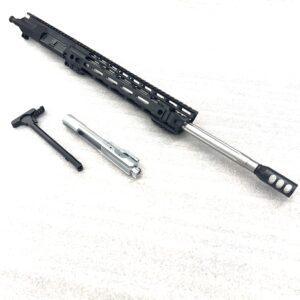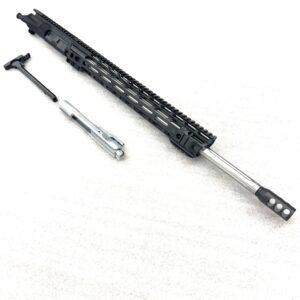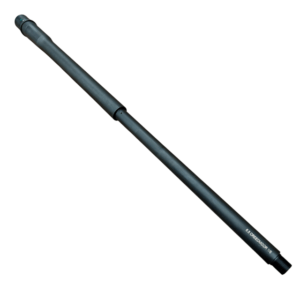
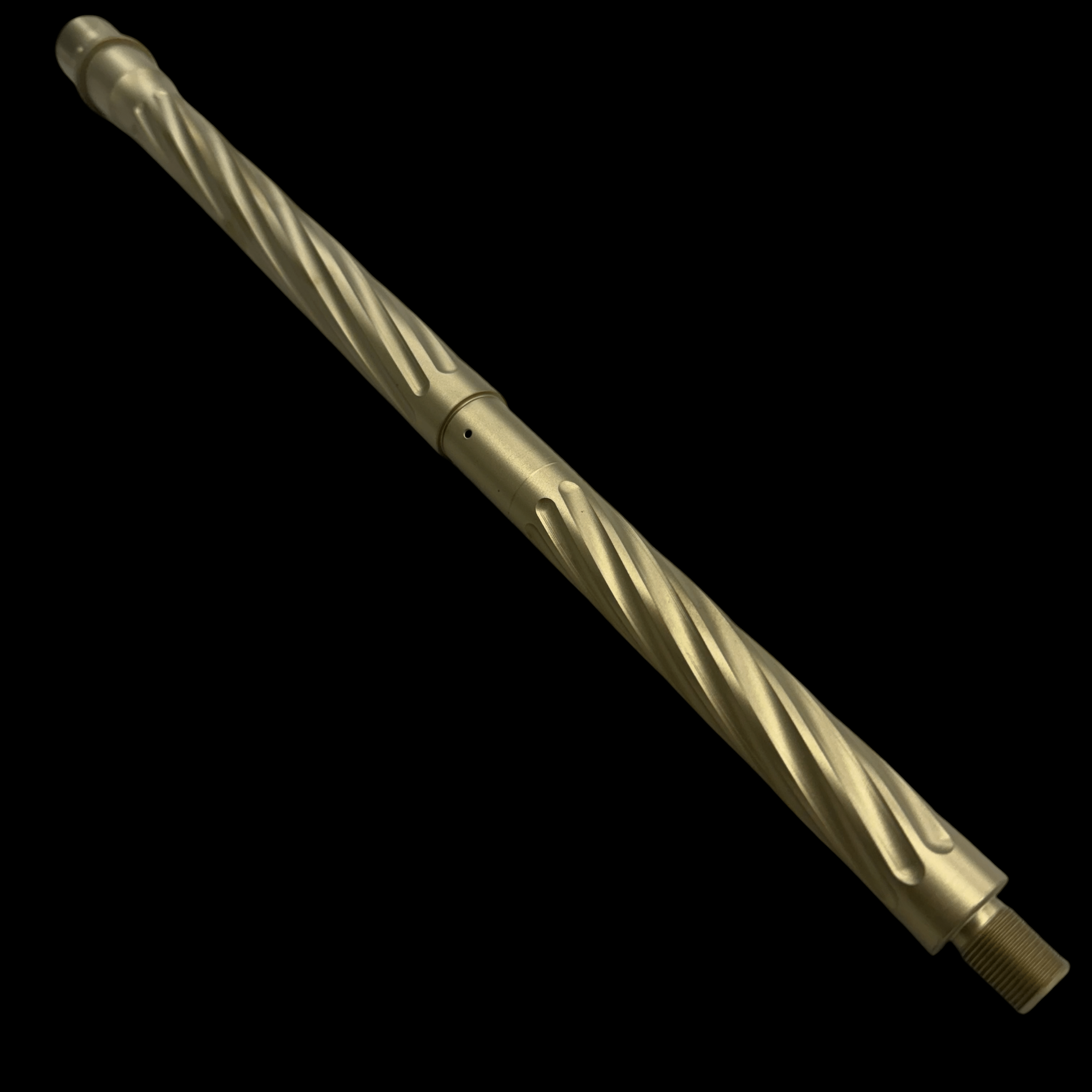
What kind of steel is it? Who makes it? How is it rifled? How do you know the bore is straight? Is the chamber checked? Is it Accurate? What about headspace?
Those are all legitimate questions when you’re buying a barrel.
A barrel is one of the most important components of an AR-15, and simply listing a material such as “4150 CMV” or “416R stainless” doesn’t tell the whole story.
At Mid State Firearms, our barrels are manufactured to defined engineering specifications with multiple stages of in-process inspection and quality control. We work with experienced OEM manufacturers that specialize in barrel production and hold our barrels to the specifications we require.
Here’s a look at what actually goes into one.
What Are Mid State Barrels Made From?
Our barrels are manufactured from one of two primary materials, depending on the specific barrel:
4150 CMV (Chrome-Moly-Vanadium) steel
or
416R stainless steel
4150 CMV
4150 CMV is a chromium-molybdenum-vanadium alloy steel commonly used for firearm barrels.
The combination of chromium, molybdenum, and vanadium contributes to the steel’s strength, hardenability, wear resistance, and durability.
It’s a popular choice for hard-use AR-15 barrels because it provides an excellent balance of durability and performance.
416R Stainless Steel
416R is a free-machining martensitic stainless steel specifically developed for firearm barrel applications.
It offers excellent machinability and is widely used in precision-oriented barrel applications.
The choice between 4150 CMV and 416R depends on the particular barrel and the characteristics we’re looking for in that product.
But the material is only the beginning.
The quality of a barrel depends on how that material is turned into a barrel.
Step 1: Cutting and Preparing the Barrel Blank
The process begins with properly specified barrel steel.
The raw material is cut to the required length and prepared for the machining process.
From there, the barrel blank undergoes the operations that create the bore, rifling, chamber, and external profile.
Step 2: Drilling the Bore
The barrel blank is drilled to create the bore.
This is one of the first critical operations because the bore needs to be properly sized and, importantly, straight.
The manufacturing specification includes a specific bore-straightness requirement.
A precision cylindrical plug gauge with a specified diameter and six-inch gauging length must pass completely through the bore under its own weight.
That’s a very different standard from simply drilling a hole through a piece of steel and calling it a barrel.
Step 3: Button Rifling
Once the bore is drilled, the barrel is button rifled.
Rifling consists of the lands and grooves inside the bore that impart spin to the projectile as it travels down the barrel.
That spin stabilizes the projectile in flight.
What Is Button Rifling?
Button rifling forms the lands and grooves by forcing a hardened rifling button through the bore.
The dimensions of the resulting bore and grooves are controlled during manufacturing.
The manufacturing specification allows bore and groove diameters to taper by no more than 0.0004 inch, and any permitted taper must be in the direction of diminishing size toward the muzzle.
That gives the manufacturer a measurable dimensional requirement rather than simply relying on visual inspection.
Step 4: Stress Relieving the Barrel
After the rifling is formed, the barrel undergoes a stress-relieving process before additional machining.
Why does that matter?
Drilling, rifling, and other machining operations can introduce internal stresses into steel.
Those stresses can potentially cause dimensional movement as additional machining is performed.
The barrels are placed vertically inside a closed retort and heated in a controlled atmosphere to approximately 550°C.
They are held at temperature for a minimum of 60 minutes and then cooled in a controlled manner before being removed and air cooled.
The specified hardness after stress relieving is approximately 26–32 HRC.
The goal is to produce a more stable piece of steel before the remaining precision machining takes place.
Step 5: Precision Profiling
The outside of the barrel is then machined to its specified profile.
Depending on the barrel, this includes features such as the:
- Gas block journal
- Barrel shoulders
- Muzzle section
- Receiver-end dimensions
- Other critical profile dimensions
These aren’t simply “close enough” dimensions.
Operators check the dimensions of the barrels as they’re being machined to ensure they remain within the specified tolerances.
The manufacturing specifications also establish surface-finish requirements.
For example, the gas block area is specified at 32 Ra or better, while the remainder of the barrel profile is specified at 120 Ra or better.
What Does Ra Mean?
Ra stands for Roughness Average and is a standardized measurement of surface texture.
A lower Ra value generally represents a smoother surface.
So a specification such as 32 Ra isn’t simply saying that the surface should “look smooth.” It establishes a measurable engineering requirement.
Step 6: Chambering
The chamber is the portion of the barrel where the cartridge sits before firing.
It is machined to the specified cartridge chambering and is one of the most critical dimensions in the entire barrel.
The chamber surface finish is specified at 32 Ra or better.
The operator checks the chamber dimensions during the machining process rather than waiting until the very end of production to discover a problem.
Quality Control Happens Throughout the Process
This is one of the most important parts of the manufacturing process.
Quality control isn’t just a final inspection.
Operators inspect the barrels as they work.
The OEM’s QC process includes an in-depth inspection system with multiple redundancies:
- Operators checking profile and chamber dimensions of EVERY PART during production
- Every fifth part being documented on a QC sheet
- Major and minor diameter callouts being recorded
- QC personnel checking workstations approximately every tenth part
- Random barrels being selected for additional inspection
This creates multiple checkpoints throughout production. Checks and double-checks and triple checks.
What Does “Tolerance” Mean?
A tolerance is the amount a dimension is allowed to vary from its specified size.
The general unspecified tolerances are:
| Dimension | Tolerance |
|---|---|
| 2 decimal places | ±0.010″ |
| 3 decimal places | ±0.005″ |
| 4 decimal places | ±0.0010″ |
| Angles | ±1° |
Specific features can have tighter tolerances where required by the engineering drawing.
That’s an important distinction: a specific dimensional callout takes precedence over a general tolerance.
Step 7: Nitride Treatment
For barrels specified with a nitride finish, the completed machined barrel is sent out for salt-bath nitriding.
Nitriding is a thermochemical treatment that hardens the surface of the steel rather than simply applying a coating over it.
The process can improve surface hardness, wear resistance, and corrosion resistance.
This is one reason nitride has become such a popular finish for modern AR-15 barrels.
Step 8: Barrel Extension and Headspace
For AR-15 barrels, the barrel extension is a critical component.
The extension interfaces with the bolt and provides the locking surfaces for the action.
The barrel extension is installed and torqued to a specified range of 115–125 ft-lbs.
But torque isn’t the only check.
Every barrel is headspace checked before the gas port is drilled.
What Is Headspace?
Headspace is the controlled relationship between the cartridge’s chamber position and the bolt when the action is closed. More specifically, the distance from the bolt face to the front of the chamber. It is checked during barrel production, and again in upper assembly with the bolt that the upper/rifle is used with.
Proper headspace is critical to the safe and reliable operation of the firearm.
This is why we consider headspace inspection an important part of the manufacturing process rather than something that should simply be assumed. When you order a complete upper with BCG from Mid State Firearms, we headspace check / test fire the upper with the exact BCG it comes with to ensure performance out of the box.
Step 9: Gas Port Drilling
After the barrel passes the headspace check, the gas port is drilled.
The gas port controls the amount of propellant gas available to operate the firearm’s gas system.
The specified gas-port diameter is controlled to ±0.002 inch.
That may sound like a small detail, but it matters.
Gas-port size can affect how a firearm cycles, and therefore it is treated as a controlled manufacturing dimension.
Step 10: Caliber Marking
Finally, the barrel is permanently marked with its caliber using laser or roll stamping.
At this point, the barrel has gone from a piece of alloy steel to a finished, inspected firearm component.
So, How Do You Know If a Barrel Is Good?
This is really the bigger question.
You can’t determine barrel quality from one specification.
“It’s 4150.”
“It’s nitride.”
“It’s 1/8 twist.”
Those specifications are useful, but none of them by themselves guarantee a quality barrel.
A properly manufactured barrel is the result of dozens of controlled dimensions and processes.
The steel matters.
The bore matters.
The rifling matters.
Bore straightness matters.
Stress relief matters.
The chamber matters.
Surface finish matters.
Headspace matters.
Gas-port dimensions matter.
And perhaps most importantly, consistency from barrel to barrel matters.
That’s why our focus isn’t simply on putting impressive specifications on a product page.
We want the manufacturing process behind those specifications to mean something.
The Bottom Line
When you buy a Mid State Firearms barrel, you’re not simply buying a piece of 4150 CMV or 416R stainless steel with rifling cut into it.
You’re buying a component manufactured through a defined process with:
- Specified barrel steel
- Controlled drilling and button rifling
- Stress relieving after rifling
- Precision external profiling
- Controlled chamber dimensions
- Bore straightness requirements
- Defined surface-finish requirements
- In-process dimensional inspection
- Nitride treatment where specified
- Barrel-extension installation to specified torque
- Headspace inspection on every barrel
- Controlled gas-port dimensions
- Final caliber identification
We believe customers deserve to know more than just what a barrel is made from.
They should be able to understand how it was made and how its quality is controlled.
That’s the standard we look for when selecting the products we put the Mid State Firearms name on.