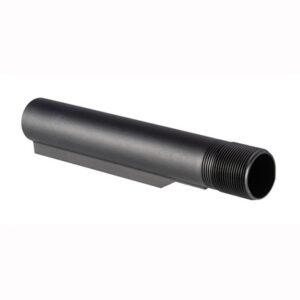
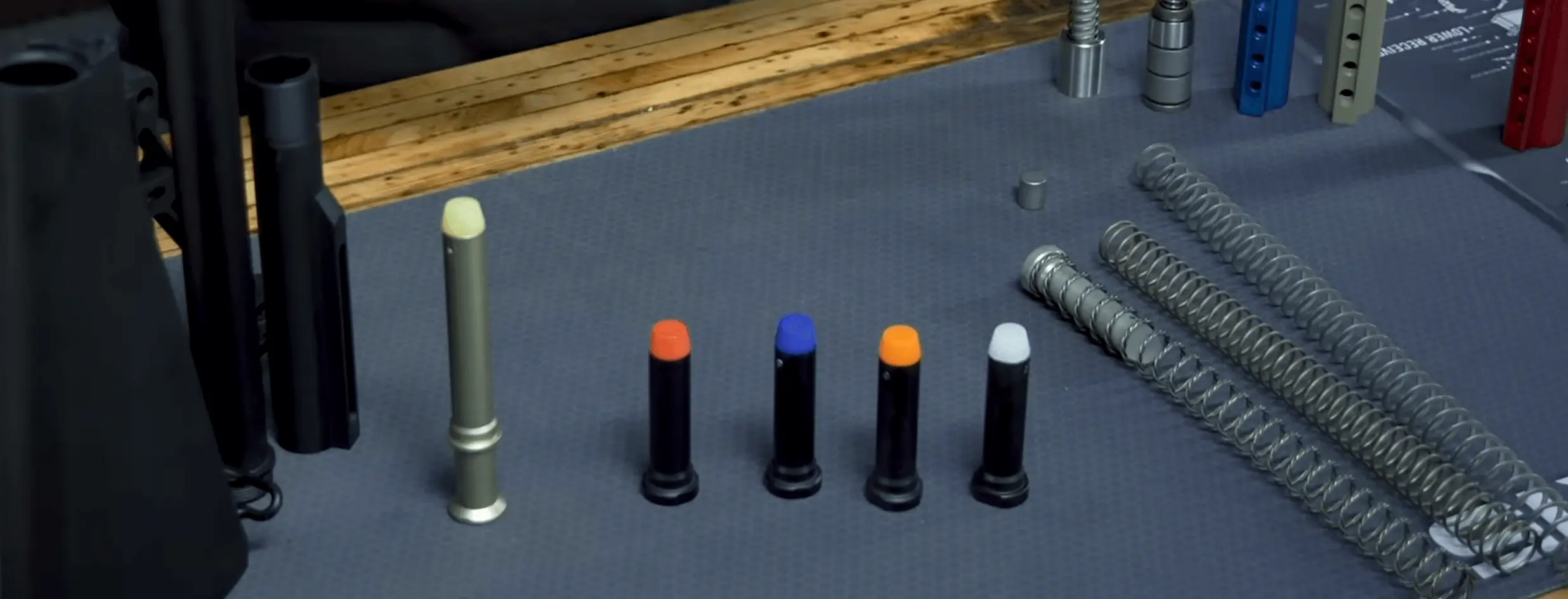
The AR-15 buffer weight is one of the quickest ways to tune how an AR-15 cycles. Carbine is the lightest common option, then H, H2, and H3 step heavier to slow the action. More mass can smooth recoil feel and help “hot” setups, but going too heavy can cause short-stroking or lost lock-back. Make one change at a time, test with your normal ammo and magazines, and consult a qualified gunsmith if problems persist.
What the AR-15 Buffer System Actually Does
The buffer system controls timing. Gas drives the carrier rearward, the spring compresses, and the buffer mass resists acceleration. The spring then returns the carrier forward to feed and lock. Too much bolt speed can feel sharp and hard on parts. Too little can cause sluggish cycling.
In plain English:
- Bolt speed: how fast the carrier moves
- Dwell time: how long gas continues pushing after the port is uncovered
If you want a clear primer on gas length and dwell, the gas system guide explains why some setups feel gassier than others.
Does buffer weight reduce recoil?
Buffer weight can change how recoil feels. A heavier buffer often smooths the impulse by slowing the action slightly, which can feel less “snappy.” It won’t remove recoil, and going too heavy can create cycling issues.
Does a heavier buffer reduce recoil?
Yes, a heavier buffer, such as H2 or H3, typically reduces the felt recoil of an AR-15. This is achieved by slowing the rearward movement of the bolt carrier group and decreasing the impact force when the carrier bottoms out. The result is a smoother shooting experience, lower muzzle rise, and reduced wear on internal components.
AR-15 Buffer Weight Basics (Carbine, H, H2, H3)
This section is your AR buffer weight guide for the common weights. The goal is “smooth and reliable,” not “heaviest possible.” These are the most common AR-15 buffer types used in standard carbine receiver extensions.
Carbine buffer vs H vs H2 vs H3: what’s the difference?
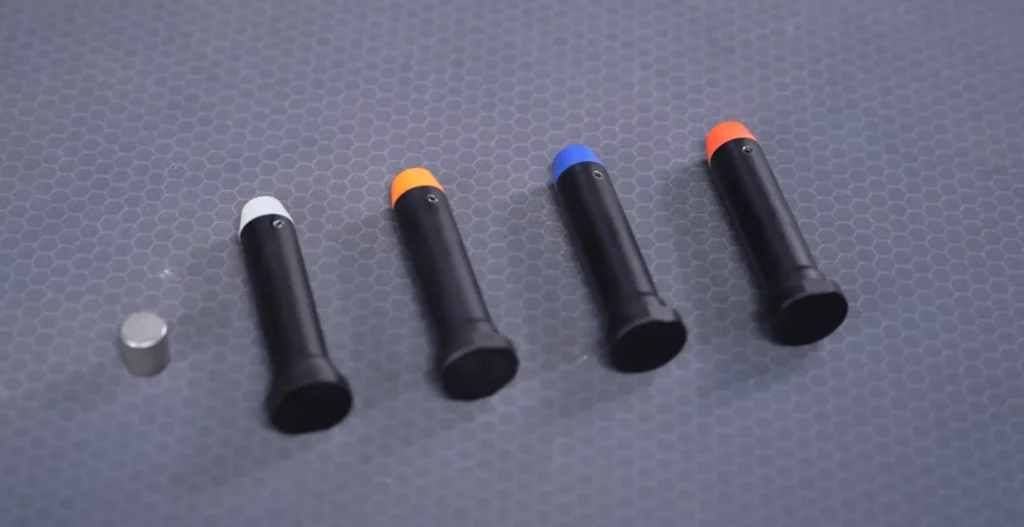
The difference is weight. Carbine is the lightest, then H, H2, and H3 get progressively heavier. Heavier buffers can tame bolt speed in overgassed or suppressed rifles, while lighter buffers can help cycling in undergassed setups.
Here is a simple AR-15 buffer weight chart with approximate weights (varies slightly by manufacturer).
| Buffer type | Typical weight (approx.) | Best for | Watch-outs |
| Carbine | ~3.0 oz | baseline, marginal gas | can feel fast in gassy rifles |
| H | ~3.8 oz | “hot” 5.56 setups | may expose weak ammo/low gas |
| H2 | ~4.6 oz | more control | can reduce lock-back if gas is marginal |
| H3 | ~5.4 oz | very gassy/suppressed | can short-stroke if gas is low |
Carbine is a safe baseline when the lock-back is consistent. H is the most common step up when recoil feels sharp, or the action feels fast, which is why the AR15 H buffer is so often recommended. H2 is for setups that still feel “over-energetic” on H. H3 is a targeted fix only when lock-back remains solid.
What does an H buffer do?
An H buffer is slightly heavier than a standard carbine buffer. The extra mass can slow the bolt carrier’s rearward speed, often reducing felt recoil and helping reliability in setups that run “hot” or overgassed.
How to Choose the Right Buffer Weight (Fast Decision Rules)
If you’re asking which AR-15 buffer I need, with what your rifle runs reliably, then adjust based on behavior. If recoil feels sharp, brass ejects forward, or the action feels overly fast, a heavier buffer (often H or H2) may help. If the rifle struggles to lock back or short-stroke, your buffer may be too heavy for the setup.
Fast if/then rules:
- Sharp recoil or “fast” feel: go one step heavier.
- Lost last-round lock-back: go one step lighter.
- Added suppressor: start one step heavier than your unsuppressed baseline.
- Don’t change multiple parts at once.
BCG issues can mimic buffer problems. The BCG explained guide helps you spot common causes of inconsistent cycling.
Use Your Ejection Pattern as a Clue (But Not the Only One)
Ejection pattern is a clue, not a verdict. The AR-15 ejection pattern buffer weight rule of thumb is that forward ejection can suggest higher bolt speed, while a 3 to 4 o’clock trend often looks more balanced. Ammo pressure, extractor/ejector condition, lubrication, and magazines can all skew ejection, so confirm with lock-back and reliability.
Buffer Weight by Common AR-15 Setups
Use these as starting points, then adjust based on symptoms.
Most common starting points:
- 16-inch 5.56 carbine gas: H
- 16-inch 5.56 midlength gas: H
- 10.3 to 12.5-inch: H2
- Suppressed 5.56: H2
16” 5.56 carbine gas (typical starting point)
For buffer weight for carbine gas system, carbine or H is common. If you’re tuning buffer weight for 16 inch AR-15, move heavier only if recoil feels sharp, the action feels overly fast, or ejection trends forward. If lock-back becomes inconsistent after going heavier, step back and re-check ammo and magazines first.
16” 5.56 midlength gas (typical starting point)
For buffer weight for midlength gas, H is the most common baseline. If the rifle still feels “hot,” test H2. If H2 causes intermittent lock-back with your normal ammo, return to H.
Is H2 too heavy for a 16-inch AR-15?
Sometimes yes, often no. It depends on the gas system, ammo, and whether you shoot suppressed. Many 16-inch rifles run well with H or H2. If you lose the last-round lock-back, that’s a sign the buffer may be too heavy (or the gas is too low).
10.3 to 12.5-inch short barrels (general guidance)
H2 is a common starting point. If the rifle still feels violent and the lock-back remains reliable, you can test heavier loads. If cycling becomes sluggish or lock-back gets inconsistent, the buffer is likely too heavy for that ammo or setup.
Suppressed AR-15 setups (general guidance)
For buffer weight for suppressed AR-15, start heavier than your unsuppressed baseline because suppression often increases backpressure and bolt speed. H2 is common; H3 can help when the action remains overly fast, and lock-back stays strong. If lock-back fails, the buffer is likely too heavy for that configuration.
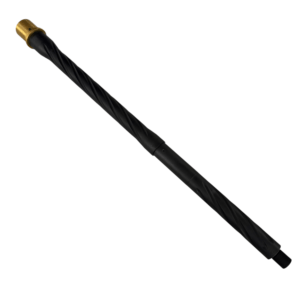
Barrel and gas choices drive many symptoms. The AR-15 barrel selection guide explains how length and gas system choices affect how “soft” or “hot” a rifle tends to run.
Signs Your Buffer Is Too Light vs Too Heavy
Symptoms are more useful than labels. This section answers most AR-15 overgassed buffer weight questions without guesswork.
Too light (common symptoms)
Sharp impulse, forward ejection, and a fast cyclic feel. That’s why carbine buffer vs H buffer is such a common first decision point.
Too heavy (common symptoms)
Sluggish cycling, short-stroking, and failures to lock back, especially with weak ammo. If you’re considering H2 vs H3 buffer, go heavier only when the rifle is clearly overgassed and still locks back reliably.
Buffer Weight vs Adjustable Gas vs Springs (What to Change First)
Start with the most reversible change. Buffers are quick to swap and easy to test. Adjustable gas can be excellent, especially suppressed, but it adds complexity. Springs matter too, but changing the spring and buffer together can hide the real cause.
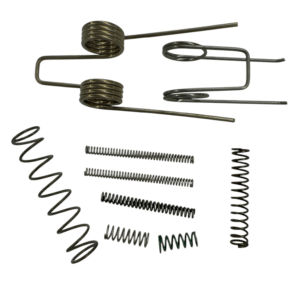
That’s why AR-15 recoil spring vs buffer weight is mostly about order: buffer first, then gas control, then springs only if needed. If you’re debating H vs H2 buffer, prove the lighter step first.
Quick Troubleshooting Checklist (No Gunsmithing Required)
Keep checks, diagnostics, and safety-first. Use consistent ammunition and a known-good magazine, and remember that ammunition pressure context is standardized through organizations like SAAMI.
- Use consistent ammo and a known-good magazine
- Confirm lubrication and smooth BCG movement
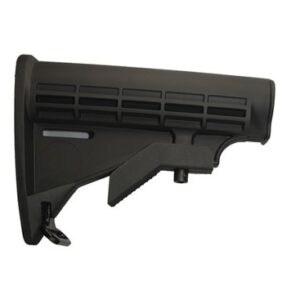
- Verify buffer and tube type match
- Use the last-round lock-back as your baseline
- Isolate suppression by testing unsuppressed
For handling reminders, the NSSF safety rules are a solid baseline. For a technical reference point on the AR family and maintenance concepts, the Army technical manual listing is available through ArmyPubs.
Key Takeaways
- Heavier buffers usually slow bolt speed and can feel smoother.
- Too light often looks like sharp recoil and forward ejection.
- Too heavy often looks like sluggish cycling and a lost lock-back.
- Use ejection as a clue, not the only metric.
- Suppressed setups often prefer more mass than unsuppressed setups.
- Change one variable at a time and retest with your normal ammo.
- If basic checks don’t stabilize the function, consult a qualified gunsmith.
- If you’re ready to tune a specific build, browse buffer options and complete uppers that match your gas system and intended use.
FAQ
Can a heavier buffer improve reliability?
Yes, when the rifle is running hot. Added mass can slow the cycle and reduce bolt speed. If the rifle starts short-stroking or losing lock-back, you went too heavy.
What buffer weight is best for .223 vs 5.56?
Lower-powered .223 can behave like weaker ammo in some rifles, especially with heavier buffers. Start from a reliable baseline and make small changes. If lock-back becomes inconsistent, the buffer may be too heavy for that ammo in that setup.
Do I need an adjustable gas block instead of a heavier buffer?
Not always. A buffer change is simpler and reversible. Adjustable gas is most useful when tuning a suppressed rifle or a clearly overgassed setup more precisely.
Does buffer weight affect accuracy?
Not directly, the way barrel quality and ammo do. Buffer weight mainly changes timing and feel. It can improve perceived control and follow-up shots, but it’s not an accuracy shortcut.
What if my rifle won’t lock back after switching buffers?
Treat it as a “too heavy or too little gas” signal. Go one step lighter and re-test with known-good mags and consistent ammo. If the issue persists, the cause may be outside buffer weight (gas, magazines, lubrication, or BCG-related).